Friday, May 27, 2022

Citation.js: New site

Citation.js: New site

I recently updated the website of Citation.js. This involved getting rid of the Material Design Lite framework, simplifying and refreshing the site design and modernisering some of the code behind it. Additionally, I updated the content of the homepage, and added some functionality to the interface of the blog page and the demo.

Homepage

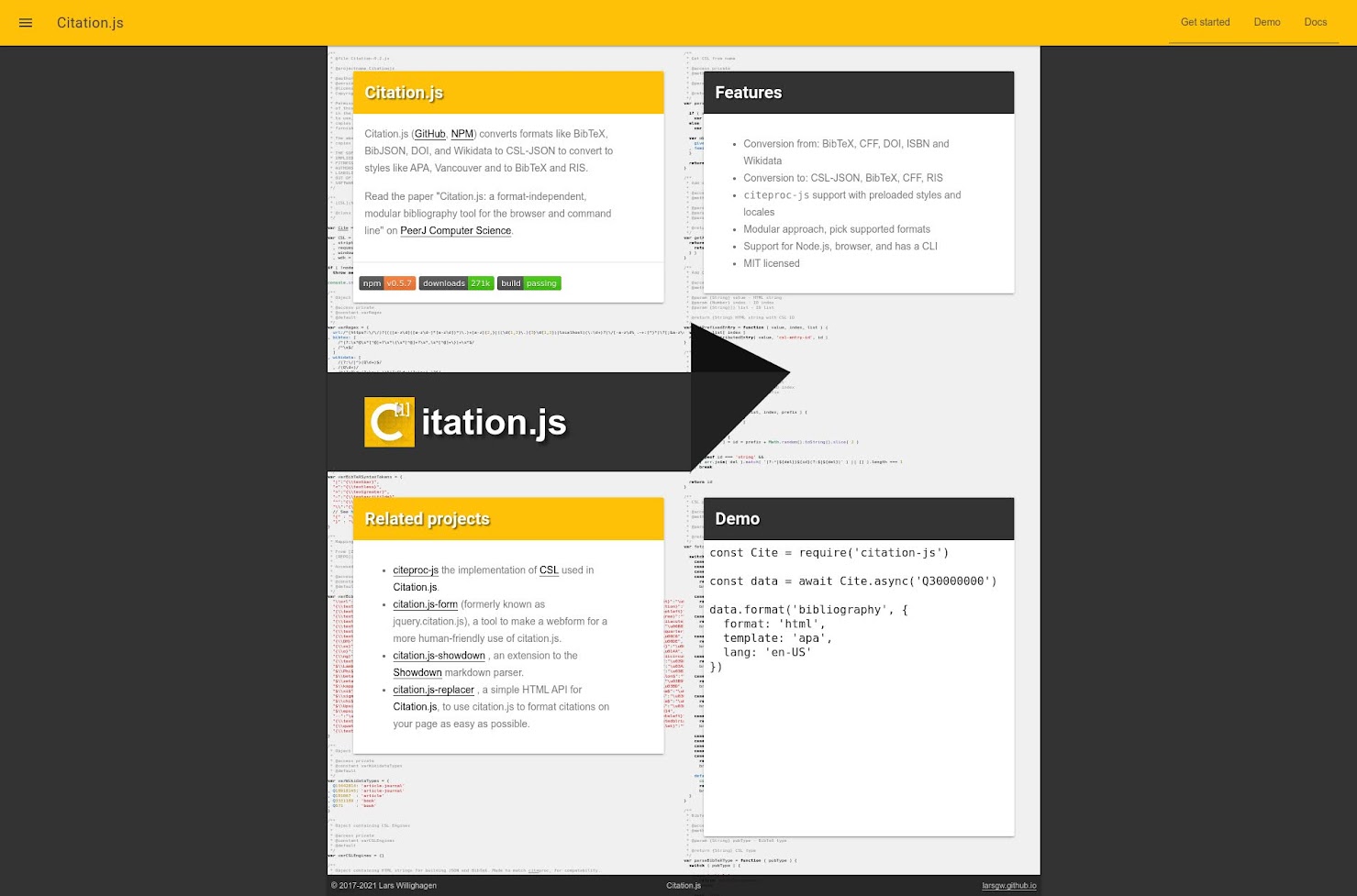
The old layout of the homepage had a dark grey background, with in the middle a grid of four cards with the main content of the site, and between the top and bottom row the Citation.js banner-variant logo. The grid of cards had a background of syntax-highlighted source code. This is actually the start of the Citation.js v2 code, which at that point still consisted of a single file. On the very top of the page was a yellow header and in the bottom a thin black footer.

The new layout incorporates a lot of the design elements of the first design, but in a way that hopefully improves the readability and feel of the page. The yellow header remains but the links are centered instead of right-aligned. The footer is full-width (though the text is still centered) and has a larger font size and vertical padding. The grid is gone, instead the top of the page has a background of code in full-width with the banner logo and some introductory text. The other content is now aligned in a single row, and the cards are replaced with plain text, although the headers still have white text with a slight shadow on a dark background.

Blog

The blog page had the same header, footer, and dark grey background in the old layout, with individual blog posts as cards and the introductory text and search bar as a slightly wider card.

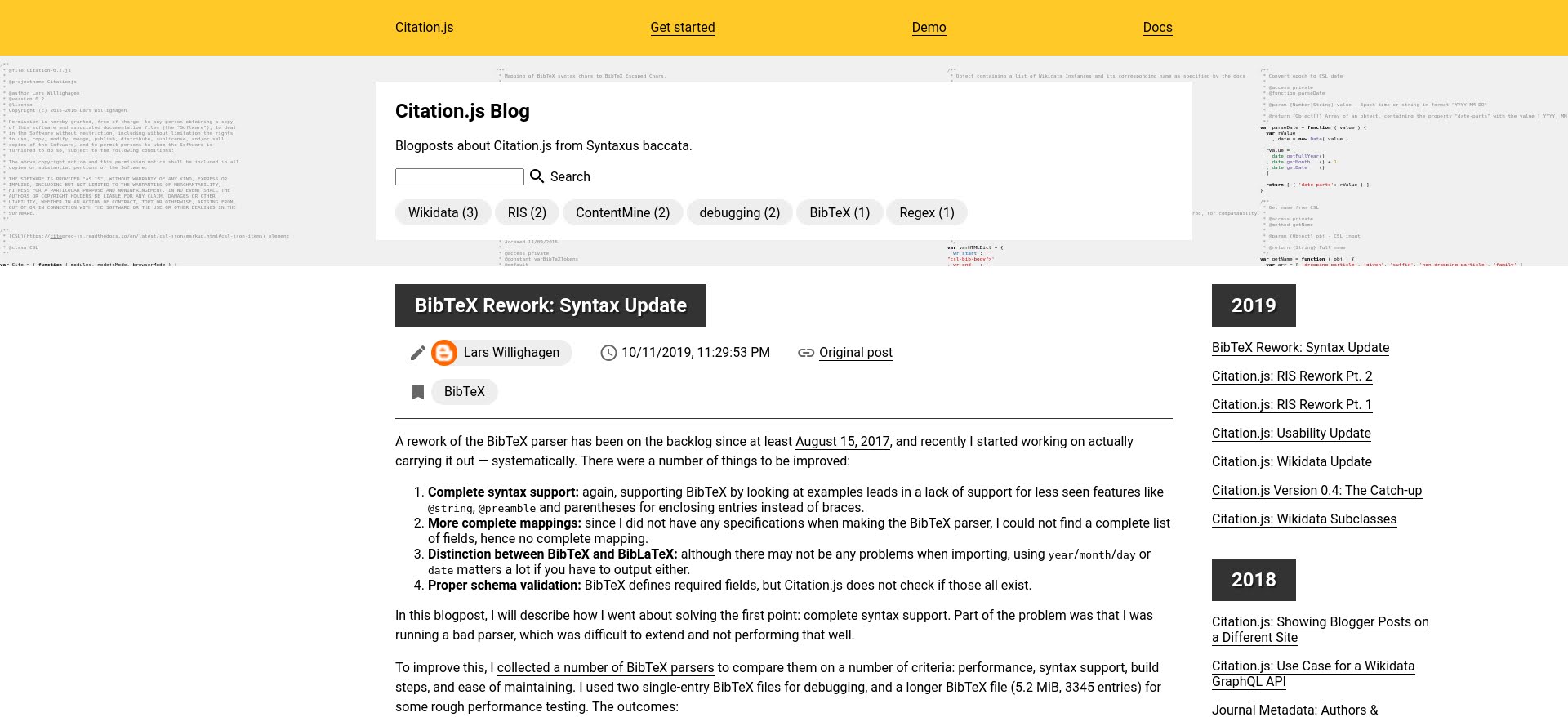
The new layout mirrors the changes to the homepage, especially the white background and full-width code background and the changing of cards to plain text. To the right of the blog content is now a sidebar listing the blog posts per year, which moves to the bottom of the page on narrow screens. Below the search bar is now a clickable list of tags.

Demo page

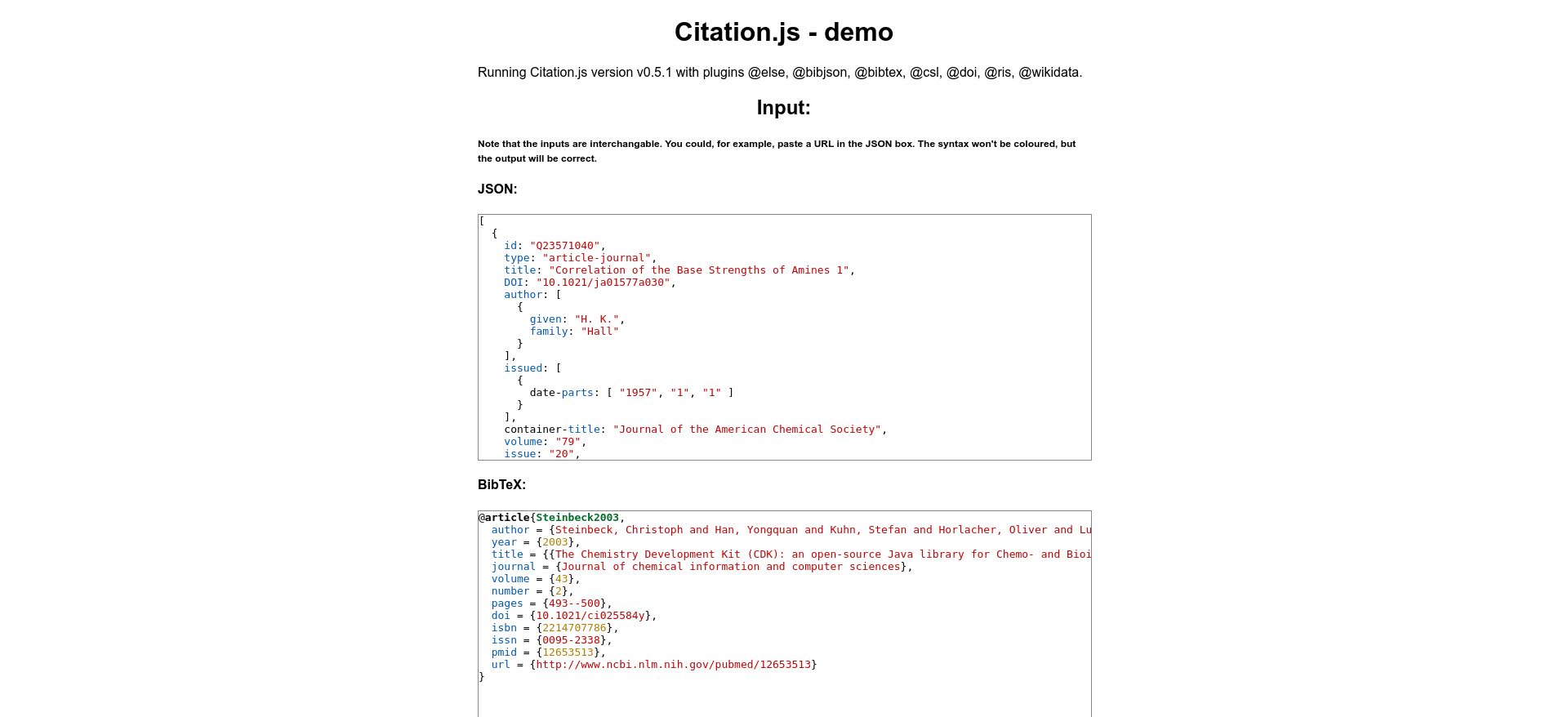
The design of the demo page has not been updated since I made it in April 2016, being more or less plain-text but with paragraphs limited in width and centered.

The new design adds the header, footer, and code background from the homepage as well as some styles for the headers. The interface of the demo is simplified at the cost of easy-to-read code. That also means that the live view of the code is removed.

API documentation

The styles of the home page now also apply to the API documentation.

Thursday, December 2, 2021

Re-implementing the upload of images for the LaTeX→HTML converter

The CDLI is developing a new website. That website’s admin interface for its journals contains a page where a LaTeX source file, following a specific template, is configured to an HTML page. For this, apart from the LaTeX file itself, two additional components are needed: a BibTeX file, containing metadata of the references; and image files.

Current implementation

The current implementation involves uploading images separately from the form that creates the article. This can lead to “orphan” images if such a form is abandoned after uploading the images. The current implementation has an additional problem, where files are saved in a single directory, so multiple images with the same file name (say, Figure1.jpg) will overwrite previous images.

ClientServerGET /admin/articles/add/cdlj200 (add page)POST /admin/articles/convert-latex200 (converted HTML, list of images)POST /admin/articles/image 'Figure1.jpg'Saves image in 'Figure1.jpg'200POST /admin/articles/add/cdlj300 /articles/<sequential ID>ClientServer

New implementation

With a new implementation of the rest of the forms, simplifying a lot of the code, the issues with the image uploads are also attempted to be resolved.

Saving images together with the metadata

To avoid the problem of the “orphan” images resulting from abandoned forms, one could submit the images in the same form that creates the article. If that form is not submitted, or contains invalid data so cannot be saved, the images will not be uploaded.

Saving images according to metadata

The second problem could be solved immediately by saving the images in subdirectories according to the metadata of the image, e.g. 2021-01/ where 2021 is the year the article is published and 01 is the article sequence number within that year. This however assumes that that metadata does not change after the initial submission.

Both these solutions however creates some constraints on other problems, because it means that the images can only be saved after the user submits the main form, so after the HTML containing <img> elements with references to the image locations is generated. Somehow, those image locations should be able to identify the article, before any information about that article is known:

ClientServerGET /admin/articles/add/cdlj200 (add page)POST /admin/articles/convert-latexAt this point the HTMLshould contain linksto the permanent locations of the images200 (converted HTML, list of images)POST /admin/articles/add/cdljAt this pointthe images are savedin a permanent location300 /articles/<sequential ID>ClientServer

So, what is the solution? I propose the following:

ClientServerGET /admin/articles/add/cdljGenerate random article ID200 (add page with embedded article id)POST /admin/articles/convert-latexGenerate image URLSaccording torandom article ID200 (converted HTML, list of images)POST /admin/articles/add/cdljVerify random article ID,save images,generate sequential ID300 /articles/<sequential ID>ClientServer

Monday, March 29, 2021

CDLI catalogue growth over time

Since Google Summer of Code 2020 I have been contributing code to the new framework of the Cuneiform Digital Library Initiative (CDLI), a digital repository for metadata, transliterations, images, and other data of cuneiform inscriptions, as well as tools to work with that data.

One of the features of the new CDLI framework is improved editing of artifact metadata, as well as inscriptions. There are several ways artifacts will be able to be edited: by uploading metadata in a CSV-format, by batch edits in the website interface, and by editing individual artifacts. At the basis of all those pathways is the database representation of individual revisions. To evaluate the planned representation, and to see if alternatives are possible, I took a look at the catalogue metadata (CDLI 2021), and what edits are being made currently.

Artifact registrations


Figure 1: The number of artifacts registered each year, split by the collection they are in. Collections with less than 7000 artifacts represented are combined into the “Other” category to keep the legend manageable. 13K artifacts without valid creation dates were excluded.

First, I took a quick look at the composition of the catalogue (Fig. 1). As it turns out some collections had most of their (included) artifacts added in a single year, such as the University of Pennsylvania Museum of Archaeology and Anthropology in 2005 and the Anadolu Medeniyetleri Müzesi in 2012. Other collections seemed to have had a more steady flows of artifact entries, particularly the British Museum. Overall, this does not help much with selecting a database representation of revisions though.

One of the options we want to evaluate is storing revisions in a linked format, similarly to how artifacts are stored now, instead of a flat format. This means that if each of those artifacts has about 10 links in total — say 1 material, 1 genre, 1 holding collection, 1 language, 1 associated composite, and 5 publications — each revision would need 10 rows for the links and 1 row for the rest of the entry. Therefore, the question is: are 11 rows per revision manageable for 343,371 active artifacts?

Revisions

To find out, let’s take a look at the daily updates of the catalogue data. With the git history, we can find out how many artifacts were edited on each day. Since the commits are made daily multiple consecutive edits to the same artifact are counted as a single revision. On the other hand, the removal of an artifact from the catalogue might be counted as a revision. Whether that balances out is hard to tell, so these numbers are a rough estimate. The analysis only goes back to 2017 unfortunately, as before that the catalogue was included as a ZIP file.


Figure 2: Number of artifact revisions per year. The 12 largest revisions are highlighted and explained below.

Figure 2 highlights in various colors the 12 revisions affecting the highest number of artifacts. Most of these are 7 consecutive in October and November of 2017. These involved editing the ID column, something which should not happen in the current system. Other large revision usually affected a single column, thereby revising almost every artifact:

  • Padding designation numbers with leading zeroes (“CDLI Lexical 000030, ex. 13” → “013”): 2020-02-11, 2018-01-26
  • Addition of new columns: 2019-09-10
  • New default values ("" → “no translation” for the column translation_source): 2018-10-30

Outside the top 12 the edits become a lot more meaningful. Often, credits for new transliterations or translations are added, sometimes with the previously undetermined language now specified.

As it turns out, approximately 3 million edits are made every year. If all those edits are stored as linked entities, we are looking at 30 million table rows, per year. However, even if the edits are stored in a flat format there would be 3 million table rows per year already. Either option might become a problem in 5–10 years, depending on SQL performance. With indexing it might not be a problem at all: usually the only query is by identifier anyway.

Changed fields

That said, let’s presume I choose the flat format. Most revisions only change one or two fields (excluding the modification date which would not be included). Duplicating the whole row might be wasteful, so what could I do to avoid that?

Since the flat format is based on the schema of the CSV files used for batch edits, each column can be considered as text, with an empty string for empty values. This leaves NULL (i.e. “no value”) available to represent “no change”. Together with MySQL’s SPARSE columns only edited fields would be stored. (Otherwise, each empty value would need to be signified as such. Now, actual values carry some extra information to the same end.)

It would also make it even easier to display a list of changes, as there is no need to compare the value with the previous one. Other operations with revisions, such as merging two revisions made simultaneously on the same version of an artifact, would be easier for the same reason.

Since this would not be possible, or not as easy, with a linked format perhaps it was good the shear volume of edits pointed me that way anyway.

References

Cuneiform Digital Library Initiative. (2021, March 8). Monthly release 2021.03 (Version 2021.03). Zenodo. http://doi.org/10.5281/zenodo.4588551

Friday, March 26, 2021

GitHub pages 404 redirection

Recently I moved the Citation.js API documentation from /api to /api/0.3, to put the new documentation on /api/0.5. I fixed all the links to the documentation, but I still got a issue request regarding a 404 error after just a few days. All in all, I had to redirect pages from /api/* to /api/0.3/* while all these pages are hosted as static files on GitHub Pages.

There are three ways I found to do this:

  1. I make otherwise empty HTML files in /api/* that redirect to /api/0.3/* via JavaScript or a <meta> tag.
  2. I make use of jekyll-redirect-from. This is equivalent to option 1, I think.

Option 1 seemed like a hassle and I do not use Jekyll so option 2 seemed out of the question as well. However, we still have option 3 to consider:

  1. I add a 404.html to the repository which gets served automatically on a 404. It then redirects to /api/0.3/* with JavaScript, and gives guidance on how to find the new URL manually if JavaScript is disabled.

404.html is just a normal 404 page with 4 lines of JavaScript:

var docsPattern = /(\/api)(\/(?!0.[35]\/)|$)/  
  
if (docsPattern.test(location.pathname)) {  
    location.pathname = location.pathname.replace(docsPattern, '$1/0.3$2')  
}

Breaking down the RegExp pattern:

  • (\/api) matches “/api” in the URL
  • (\/(?!0.[35]\/)|$) matches one of two things, immediately after “/api”
    • Either $, the end of the string (like “https://citation.js.org/api” without the trailing slash)
    • Or \/(?!0.[35]\/), which matches a forward slash ("/api/") followed by anything except “0.3” or “0.5”. This is to avoid matching things like “/apical/” or “/api/0.3/does-not-exist”.

This is not the neatest solution but I like it conceptually. It shows a bit of potential for Single-Page Applications as well: you can serve the same HTML+JavaScript for every possible path without having to rely on URLs like https://example.org/#/path/page. The problem is that you still get the 404 HTTP status (as you should), so if a browser or search crawler decides to care you have a problem.

Try it out now: https://citation.js.org/api/

The new "Page not Found" page in the same style as the homepage.

Wednesday, February 24, 2021

Mid-week effect of Dutch COVID-19 case reporting

Every week since the start of January I heard headlines like “3963 new infections, a bit more than average”. In context, that meant that the amount of positive COVID-19 that day was higher than the average daily amount of cases in the previous seven days. Even though we heard that every week, overall the cases were going down. What was going on? Well, somewhat unsurprisingly, the amount of reported cases was higher on weekdays than on Monday and in the weekend. The news site I linked above mentions the midweek-effect as well, but on Twitter and on the radio you mainly hear the headline, not the caveats.

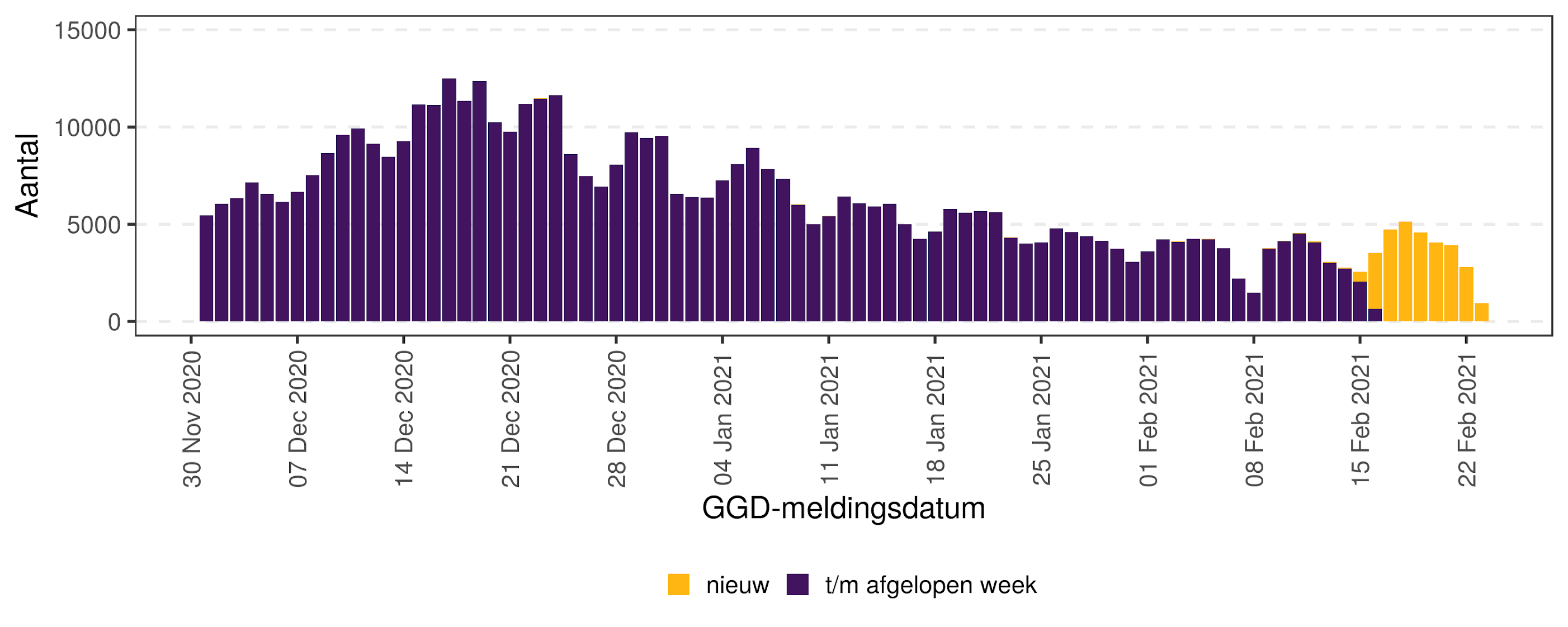
Anyway, I wanted to see what the midweek-effect actually looked like. The daily infection data is available from the RIVM website, RIVM being the Dutch National Institute for Public Health and the Environment. I started by reproducing the graph they made, partly to check the file and partly for fun (see Fig. 1).

Amount of new cases on each GGD notification date
Figure 1: Amount of positive COVID-19 tests since the start of December. The date used is the date when the test result was reported to the GGD, the municipal health service. In yellow are the test results RIVM got this week, in purple previous data.

To decompose the various effects in this data, I used R’s stats::stl() function on a time series with frequency=7. This took a while to figure out, as a mis-configuration on my end of the time series led to STL interpreting each day as a season, instead of each week. Because the seasonal effect is multiplicative and not additive, I had to log-transform the data as well. This means the seasonal component has a higher amplitude when the overall amount of cases is higher (see Fig. 2).

Seasonal component and trend of data previously shown
Figure 2: Weekly component and general trend of positive COVID-19 tests, overlayed on daily data. The solid line indicates the overall trend, while the dashed line combines the overall trend with the seasonal component. Yellow still indicates test results from this week, purple the previous data.

In the end, this does not mean much at all. The accepted explanation of the midweek-effect has to do with when tests are carried out and reported; not when infections actually take place. If we look at the cases where the date of disease onset is available (source, Public Domain Mark 1.0), the weekly trend is less present (see Fig. 3).

Seasonal component and trend of new cases per day of disease onset
Figure 3: Number of new confirmed cases per day of disease onset. The solid line indicates the overall trend, while the dashed line combines the overall trend with the seasonal component. The gray area show daily cases.

Comparing the two weekly trends, the midweek-effect of reported cases is higher than the weekly effect of the disease onset of cases. In addition, the latter peaks on Mondays and declines throughout the week before as opposed to the midweek-effect (see Fig. 4). Whether this effect is actually present or another artifact of data reporting is unclear to me.

Weekly pattern of GGD test results and reported disease onsets
Figure 4: Weekly component of reported cases and disease onsets. The solid line shows the pattern for the day of disease onset, the dashed line for the day when the test result is reported.

Monday, March 23, 2020

Economics of open source versus open science

Common postman

Common postman (Heliconius melpomene) on a Lantana

Almost two years ago I started participating on the then-new (now-archived) npm forum. I had been using npm for a few years at that point, and I had some free time to spend providing technical support, for fun. I fixed a number of bugs in the CLI, and users thanked me for those. My impact was limited, but the work was fulfilling. That is, until the developers at npm I had been working with got laid off.

Later in 2019 came the second hit: shortly after a popular JavaScript library started displaying ads to fund maintainers raised a ruckus on Twitter, npm started banning terminal ads. The ensuing chaos was a wake-up call for me. Lots of people started talking about the economics of open-source development, suggesting that open source is a fake ideology propagated by tech companies in Silicon Valley to generate value at no cost — to the companies, that is.

We were putting hours and hours of work into some ideology, and the corporations that profited from our open-source libraries gave us nothing in return. Everyone keeps laughing about the enormous dependency trees of Node.js projects, but that also means every project depends on a lot of other open-source projects, mostly by unpaid maintainers. Similarly, the bugs that I fixed for the npm CLI had a very small impact in the grand scheme of things, but npm is used by almost every company that uses JavaScript — most likely including Google, Amazon, Apple and Facebook. And a small percentage multiplied by almost all the tech capital in the world is still quite a lot.

This contradicts with what I have been taught about Open Science: ideally, all aspects of all science should be open to everyone, to allow small players to take part. The more small players can take part, the better the science is, both morally and in quality & quantity.

While in the tech world, a small but vocal group is trying to bring about a revolution to rethink open source to help the individual, at the same time the science community has just gotten into the idea of expanding open source — again, to help the individual. Is open science just a few years behind open source?

One important thing to note is that both revolutions are trying to bring about the same thing: fair representation. In fair open source, this is about maintainers of public infrastructure (in the form of libraries) getting part of the profit generated by companies using it. In open science, this is about letting everyone take part in science, from people without affiliation to people whose institution cannot or does not want to pay for access, and lowering the barrier by making source code and data available.

The main difference is probably that scientists usually get paid, at which point it is easier to choose whether to make your work open or not: not making it open would be a waste. Additionally, there is the notion that any science is good for science (and the world) as a whole: even if commercial pharmaceutical companies get to use open research (and open source software) from researcher that they did not fund, advances in pharmaceutics are good for everyone. Plus, open science helps the smaller players, which would be beneficial for competition and so prices (if market forces finally follow through).

In the middle of this is me. I maintain an open-source project (Citation.js) aimed at people who care about bibliographical data — e.g. scientists and librarians. It has 142 stars on GitHub. I am proud of it. Neither side really applies to me: I cannot think of any commercial application that needs my library, nor do I receive funding for working on a (very small) part of the scientific community. So, which revolution should I follow? Fair open source or open science?

At the moment, I am fine with keeping it as it is. Though tiresome, it is also fulfilling, and right now I can still use the Exposure™. For the longer term, I guess I will naively carry on until I burn out or someone convinces me otherwise.


Note: a proposed solution for fair open source is the Parity Public License: it allows people to use it in private without limitations, and otherwise it requires the project using it to be open-source as well. Additionally, it is possible to buy licenses for closed-source work. To me, it seems a bit limited. Licenses like this can quickly become complex to use. Do I want people to be able to use Citation.js on their personal website without making the website open source? I do not think that would be possible with this license, without personally giving permission to people who would want that.

There are probably better blog posts to be read about the trade-offs of such licenses. If you find any, I will add them here.

Friday, October 11, 2019

BibTeX Rework: Syntax Update

BibTeX Rework: Syntax Update

A rework of the BibTeX parser has been on the backlog since at least August 15, 2017, and recently I started working on actually carrying it out — systematically. There were a number of things to be improved:

  1. Complete syntax support: again, supporting BibTeX by looking at examples leads in a lack of support for less seen features like @string, @preamble and parentheses for enclosing entries instead of braces.
  2. More complete mappings: since I did not have any specifications when making the BibTeX parser, I could not find a complete list of fields, hence no complete mapping.
  3. Distinction between BibTeX and BibLaTeX: although there may not be any problems when importing, using year/month/day or date matters a lot if you have to output either.
  4. Proper schema validation: BibTeX defines required fields, but Citation.js does not check if those all exist.

In this blogpost, I will describe how I went about solving the first point: complete syntax support. Part of the problem was that I was running a bad parser, which was difficult to extend and not performing that well.

To improve this, I collected a number of BibTeX parsers to compare them on a number of criteria: performance, syntax support, build steps, and ease of maintaining. I used two single-entry BibTeX files for debugging, and a longer BibTeX file (5.2 MiB, 3345 entries) for some rough performance testing. The outcomes:

Using Time (single entry) Time (3345 entries) Syntax
Current TokenStack ~8ms ~1800ms old
Idea moo, Grammar ~2ms ~1150ms old
Idea (new) moo, Grammar ~3ms ~750ms new
Generator moo, nearley ~20ms N/A new
astrocite PEG.js ~9ms ~1670ms new
fiduswriter biblatex-csl-converter ~160ms ~119000ms new
Zotero BibTeX translator ~180ms ~31000ms old

So, the current parser was performing pretty well actually, especially compared to astrocite which I still consider a good target to aim for. TokenStack, however, was an unnecessarily complex part resulting in poor performance — and poor maintainability.

I had some trouble with PEG.js so I turned to other approaches. One thing I came across was nearley. However, this would introduce both an extra build step and an extra run-time dependency, and as the table shows did not perform very well. I assume that is on me, and my grammar-writing capabilities. One good thing that did come out of it was the use of a tokenizer or lexer, like moo.

After nearly finishing an approach using moo and Grammar, a simplified version of TokenStack with built-in support of rules, something else came up and I dropped the subject for about a year. However, recently I started over, saw my old approach and copied some stuff from there. This resulted in a even more simplified Grammar, with only matchToken, consumeToken and consumeRule support — no backtracking was needed in the end. Also, the performance was pretty good, and it was easier to implement the new syntax.

nearley grammar diagram

To make sure I had good results, I took some other parsers: Fidus Writer’s biblatex-csl-converter package and the Zotero BibTeX translator. The former was easy to set up, as it was just an npm package, while the latter involved quite some tricks: installing the Translation Server directly from GitHub, pointing an ENV variable to its config directory and running a piece of setup code, collecting all the translators I presume. Neither seemed to perform well in comparison to either my old parser, my new parser or astrocite, and I stress-tested all of them in terms of syntax:

@String {maintainer = "Xavier D\\'ecoret"}

@
  %a
preamble
  %a
{ "Maintained by " # maintainer }

@String(stefan = "Stefan Swe{\\i}g")
@String(and = " and ")

@Book{sweig42,
  Author =	 stefan # and # maintainer,
  title =	 { The {impossible} TEL---book },
  publisher =	 { D\\"ead Po$_{e}$t Society},
  year =	 1942,
  month =        mar
}

One area of expansion is all the ways BibTeX has to escape Unicode characters. Besides diacritics, which I should support completely, I think Zotero and astrocite are ahead in terms of completeness of symbols like \copyright. Then again, there is a great, really big list of LaTeX symbols, and not everyone needs every symbol — nor is everything represented in Unicode. I think the best way to do this is to expose function in the configuration to expand the default supported macros, but let me know if something else comes to mind.

The new parser, in its current form, has been published as part of Citation.js v0.5.0-alpha.3.